Redefining how humanity
designs, tests & powers flight.
VIMANA-X combines AI-native automated experimentation, solid-state electrohydrodynamics (EHD), and autonomous digital-twin infrastructure to pioneer whisper-quiet, software-defined flight platforms.
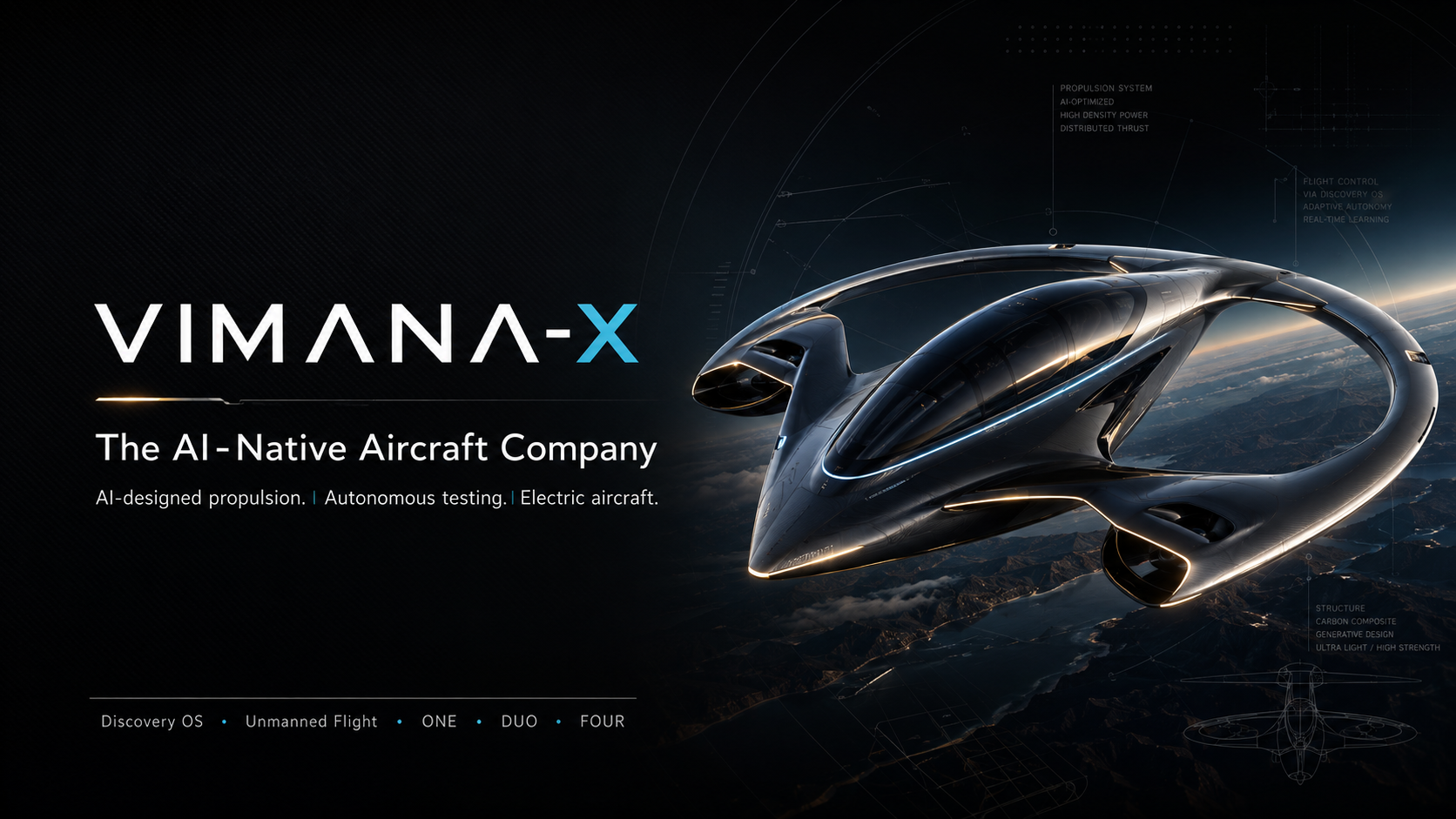
Concept render — design study, not existing hardware
A goal for a solid-state platform, not a measured result. No VIMANA-X vehicle has been acoustically characterised.
Simulation dispatch, evidence capture, and approval gates run through our own control plane. Throughput figures follow once the baseline is published.
Every claim on this site is labelled with its level under VXM-RSC-EVD-001, from E0 (claim only) to E7 (operational validation).
Interactive 3D Aircraft Avionics & Flow Dynamics
Experience the aerodynamics of the VIMANA flight envelope. Move your cursor across the cockpit canvas to manipulate pitch, roll, and boundary-layer ionization vectors in simulated real time.
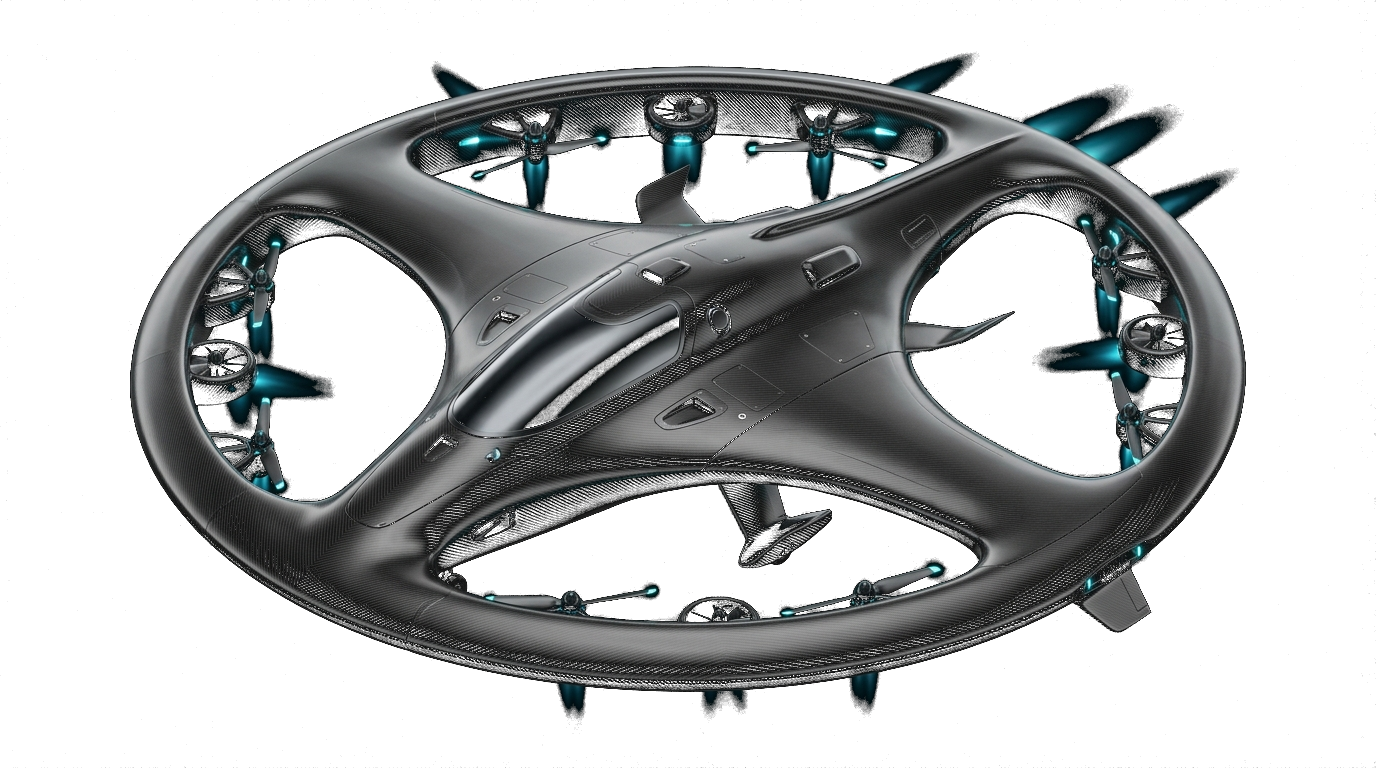
The VIMANA Flywheel:
Where AI acceleration meets physics.
Traditional aerospace R&D takes decades. We compress the discovery cycle through a vertically integrated research engine that unifies computational chemistry, electrohydrodynamics, and automated physical test cells.
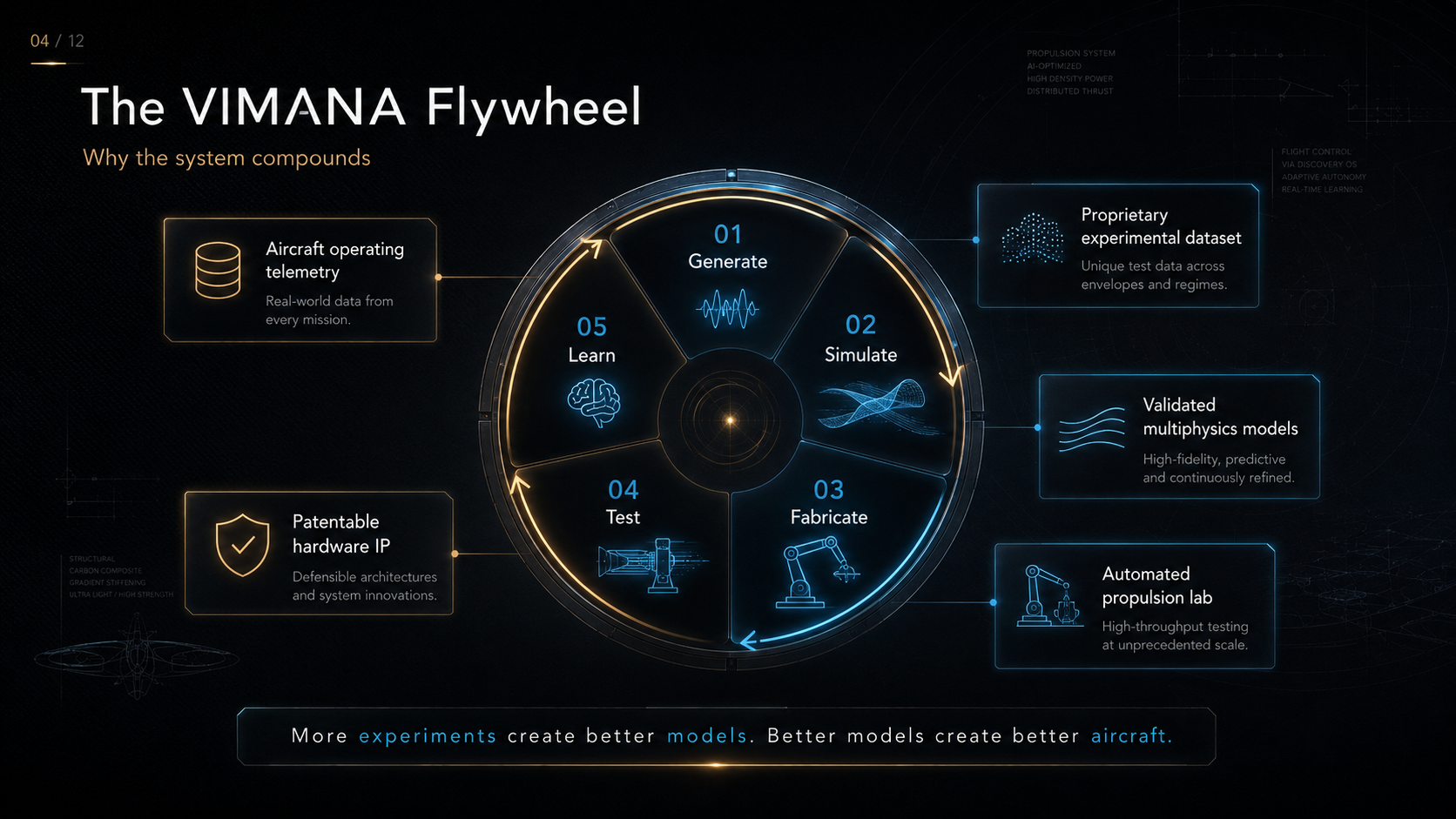
Autonomous Discovery OS
Continuous AI agent-driven experimental design, parameter sweep automation, and simulation-to-lab correlation.
Electrohydrodynamic Thrust Simulator
Adjust applied potential, electrode spacing and altitude to see how a simplified ion-drag relation behaves. A teaching model, not a design toolIllustrative · E1Illustrative. Evidence level E1: Theoretical support. A simplified one-dimensional Mott relation for ion-drag thrust, used for illustration only.
It ignores corona onset voltage, space-charge limits and electrode geometry, and it has not been validated against VIMANA-X hardware. Treat the outputs as orders of magnitude, not predictions.
From algorithmic discovery to certified flight platforms.
We monetize our core technology at every tier of the product ladder, generating intellectual property, simulation SaaS, and subsystem revenues long before passenger aircraft certification.
Discovery Infrastructure
Discovery OS, simulation pipelines, knowledge graph, automated test chamber robotics.
Propulsion Subsystems
High-voltage solid-state thrusters, dielectric barrier discharge, power density topologies.
Specialized UAV Systems
Silent subscale prototypes, high-altitude atmospheric sampling UAVs, sensor testbeds.
Aircraft Platforms
VIMANA ONE, VIMANA DUO, and VIMANA FOUR passenger and cargo aerospace vehicles.
Platform Economics
OEM aerospace licensing, engineering simulation SaaS, IP royalties, defense integration.
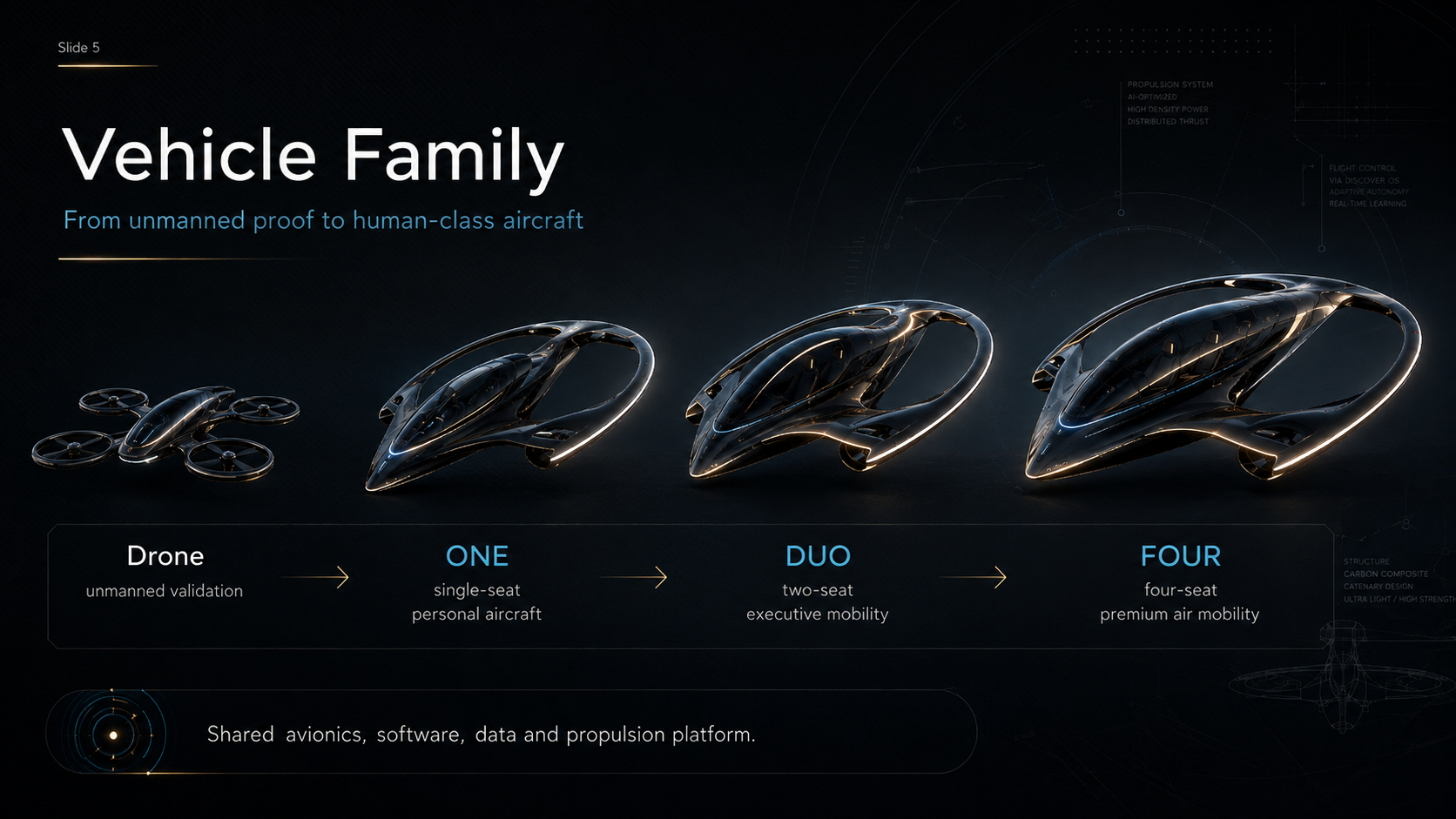
VIMANA ONE
Tech DemonstratorSingle-operator aerospace research vehicle engineered to validate full-scale solid-state aerodynamic boundary layer ingestion and high-voltage atmospheric control.
The VIMANA Fleet
Every cubic centimeter of the VIMANA airframe is engineered for solid-state propulsion, high-voltage containment, and zero-compromise aerospace safety. Choose your vessel.
VIMANA ONE
A striking fusion of hyper-aerodynamics and stealth. VIMANA ONE redefines unmanned precision. Engineered for zero-emission, silent penetration of hostile airspace, it is the ultimate expression of our solid-state propulsion mastery. Pure, unadulterated performance.

The quietest propulsion platform in aerospace history.
Noise is the existential barrier to urban air transportation and tactical reconnaissance. By eliminating rotating blades entirely, VIMANA-X delivers silent flight that seamlessly blends into ambient city noise.
VIMANA Solid-State Flight (target)
No rotating blades means no blade-passage or blade-vortex noise, which is the dominant source in the two rows above. The 42 dBA figure is our design target; no VIMANA-X vehicle has been acoustically measured.
$195B Addressable Market Across Three Horizon Tiers
Unlike capital-intensive single-vehicle bets, VIMANA-X captures value across software simulation, subsystem aerospace licensing, and certified airframes.
Commercial Silent Air Mobility
Urban and regional passenger transport operating within noise-restricted metropolitan corridors exempt from standard rotorcraft curfew bans.
Capital-efficient aerospace discovery with multi-tier monetization.
We eliminate the traditional "billion-dollar binary outcome" trap of aerospace startups. By generating revenue from software, subsystem IP, and unmanned platforms first, we build durable equity value at every step.
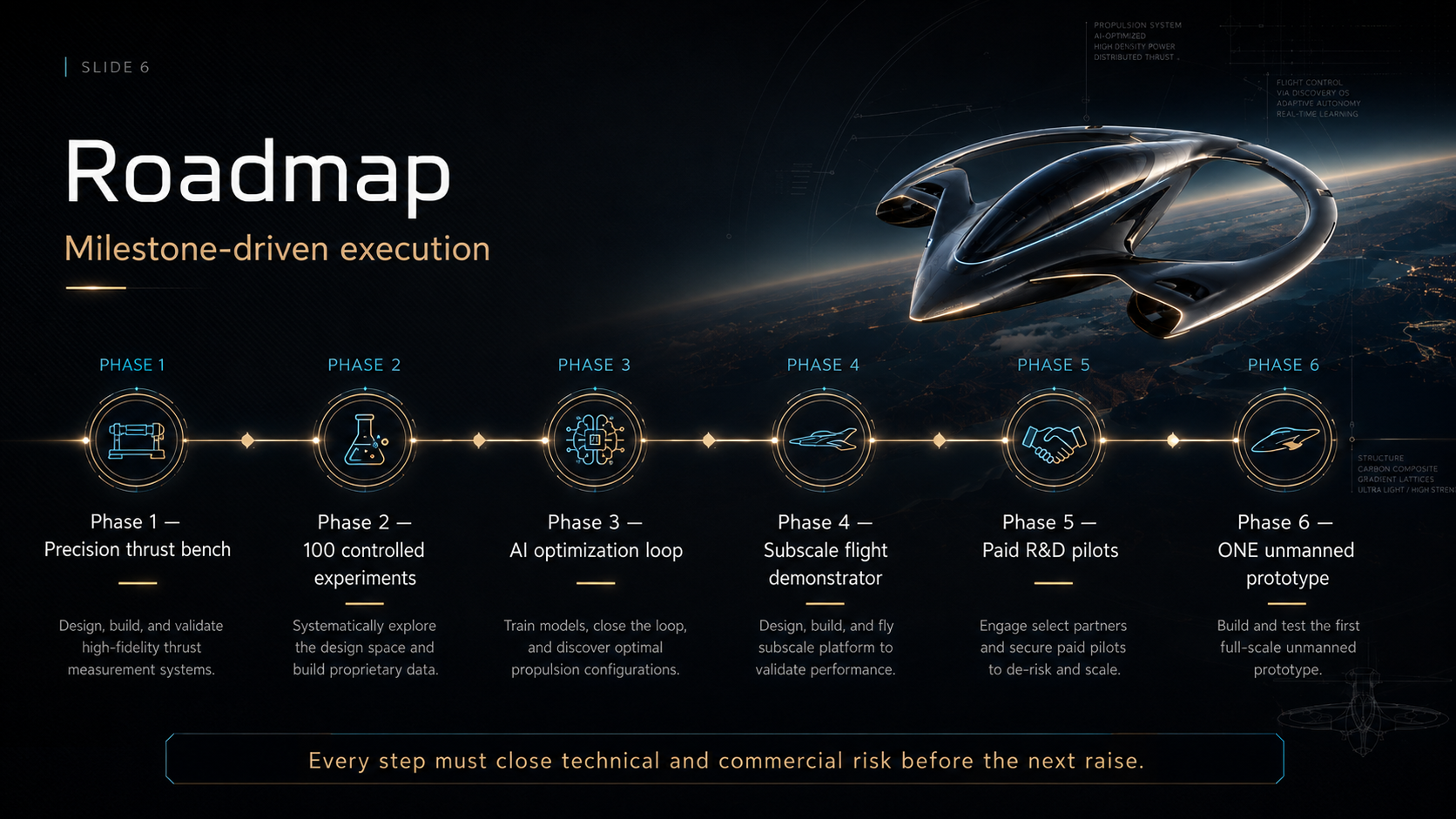
Control plane & evidence discipline
- Governance control plane running registries, approvals, release gates and audit events.
- Claim ladder wired into the public site, so every figure shows its evidence level.
- Electrode and test-rig design work ahead of the first instrumented bench campaign.
Instrumented bench campaign
- Load-cell thrust measurement with calibrated DAQ across a defined electrode matrix.
- Project NULL controls to separate genuine effects from corona and thermal artefacts.
- First VIMANA-X originated evidence records at E3, with raw data retained.
Subscale demonstrator & IP
- Tethered subscale testbed instrumented for thrust, acoustics and power draw.
- Patent filings on electrode and power-electronics topologies.
- Independent replication of the bench results by an external lab.
Certification basis & platform
- Select the target product and jurisdiction, and agree a certification basis with the regulator.
- Full-scale unmanned platform, subject to Phase II and III results.
- Commercial model confirmed once acoustic and endurance data exist.
Contains the cap table, claims register with evidence levels, research source registers, and financial model.
The Evidence Ladder:
No claim exceeds its physical proof.
Aerospace is plagued by unverified concept promises. At VIMANA-X, every technological claim is governed by standard VXM-RSC-EVD-001. A claim’s status can never outpace the maturity of its empirical verification data.
A stated idea, or a claim with theoretical support. No data behind it yet.
Formulated with stated assumptions and error bounds, and supported by simulation.
Measured on a bench with calibrated instrumentation, then repeated internally.
Independently replicated outside VIMANA-X. One successful test does not establish generality.
Validated at vehicle or system level, then in operational use.
Immutable Audit Trail
Signed raw data is retained, and corrections create a new version rather than overwriting the original. Negative results are kept alongside positive ones.
Strict Separation of Authority
Requesters cannot approve their own claims. Autonomous AI agents propose simulation runs, but only certified aerospace human engineers can validate and transition flight gates.